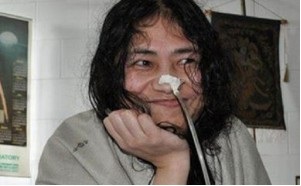
Irom Sharmila Chanu (born March 14, 1972), also known as the "Iron Lady of Manipur" or "Menghoubi" ("the fair one") is a civil rights activist, political activist, and poet from the Indian state of Manipur. Since 2 November 2000, she has been on hunger strike to demand that the Indian government repeal the Armed Forces (Special Powers) Act, 1958 (AFSPA), which she blames for violence in Manipur and other parts of India's northeast. Having refused food and water for more than 500 weeks, she has been called "the world's longest hunger striker".
On November 2, 2000, in Malom, a town in the Imphal Valley of Manipur, ten civilians were allegedly shot and killed by the Assam Rifles, one of the Indian Paramilitary forces operating in the state, while waiting at a bus stop. The incident later came to be known to activists as the "Malom Massacre". The next day's local newspapers published graphic pictures of the dead bodies, including one of a 62-year old woman, Leisangbam Ibetomi, and 18-year old Sinam Chandramani, a 1988 National Child Bravery Award winner.[
Sharmila, the 28-year-old daughter of a Grade IV veterinary worker, began to fast in protest of the killings, taking neither food nor water. As her brother Irom Singhajit Singh recalled, "The killings took place on 2 November 2000. It was a Thursday. Sharmila used to fast on Thursdays since she was a child. That day she was fasting too. She has just continued with her fast". 4 November is also given as the start day of her fast. On the Friday third of November she has a last supper of pastries and sweet things then she touches her mother's feet and asks permission to fulfill her bounden duty. Her primary demand to the Indian government was the repeal of the AFSPA, which allowed soldiers to indefinitely detain any citizen on suspicion of being a rebel. The act has been blamed by opposition and human rights groups for permitting torture, forced disappearances, and extrajudicial executions.
Three days after she began her strike, she was arrested by the police and charged with an "attempt to commit suicide", which is unlawful under section 309 of the Indian Penal Code, and was later transferred to judicial custody. Her health deteriorated rapidly, and the police then forcibly had to use nasogastric intubation in order to keep her alive while under arrest.Since then, Irom Sharmila has been regularly released and re-arrested every year since under IPC section 309, a person who "attempts to commit suicide" is punishable "with simple imprisonment for a term which may extend to one year or with fine, or with both".
By 2004, Sharmila had become an "icon of public resistance". Following her procedural release On 2 October 2006, for around four months, Irom Sharmila Chanu went to Raj Ghat, New Delhi, which she said was "to pay floral tribute to my idol, Mahatma Gandhi." Later that evening, Sharmila headed for Jantar Mantar for a protest demonstration where she was joined by students, human rights activists and other concerned citizens. On 6 October, she was re-arrested by the Delhi police for attempting suicide and was taken to the All India Institute of Medical Sciences, where she wrote letters to the Prime Minister, President, and Home Minister. At this time, she met and won the support of Nobel-laureate Shirin Ebadi, the Nobel Laureate and human rights activist, who promised to take up Sharmila's cause at the United Nations Human Rights Council.
On 23 August 2011, Sharmila was involved in the wave of Anti-corruption movement on invitation by Anna Hazare via letter. Following Mr Hazare's promise to visit Imphal and support Sharmila there he announced in an interview with NDTV on September 13 that he would be sending two representatives to meet with Sharmila soon to prepare for the meeting
Sharmila was nominated to the 2005 Nobel Peace Prize by a Guwahati-based woman's organization, the North East Network.
She was awarded the 2007 Gwangju Prize for Human Rights, which is given for "an outstanding person or group, active in the promotion and advocacy of Peace, Democracy and Human Rights". She shared the award with Lenin Raghuvanshi of People's Vigilance Committee on Human Rights, a northeastern Indian human rights organization. In Addition the largest monetary prize the first Rabindranath Tagore Peace Prize was given to her in 2010 by the New Delhi IIPM.She was awarded the Sarva Gunah Sampannah ‘“ Award for Peace and Harmony" aka the 12th Signature Women of Substance award (Assam) also in 2010. 2009 she was awarded the first Mayillama Award (Kerala). And in 2010 in the presence of the Law Minister Sri V Moilly in Bangalore she was awarded in absentia a lifetime achievement award. She was most recently awarded an Adivasi Ratna award accepted by her brother.
On 28 November 2010, UK Green Party leader and European Parliament member Keith Taylor wrote to the Indian government seeking the release of Sharmila and the repeal of the AFSPA.[21] Her main supporter in the European Union is Sir Graham Watson KB MEP chair of the India/EU delegation of MEPs. He has consistently made interventions on her behalf most recently to Dr J Bhagwati Indian Ambassador to the EU who responded on 1 July 2011 to his request to respond to the death threats made against Irom Sharmila. Indian Ambassadors reference BRU/AMB/48/2011 Embassy of India, 1050 Brussels. He responds only that he understands that Irom Sharmila is a hunger striker and that the modification of AF(SP)A is under consideration. Previously in April 2011 Sri Graham Watson and the EU delegation had tried to visit Manipur but were not allowed to do so by the Indian Authorities. They visit each year this year they were allowed to visit, Delhi, Patna and Mumbai. Although Keith Taylor did write three letters on one occasion he has never responded to further input. Sri Graham Watson and other members of the EU delegation do always respond to further requests for help. For example a Dutch member of the India EU delegation Peter Van Dalen whose special interest group is Dalit and subaltern groups released this press statement for publication at the gathering at her tenth anniversary of fasting in November 2010 Smt Sharon Bowles MEP sent Sharmila a personal letter of support which is now with Sharmila. She had added her personal regret that Sharmila was not nominated for the Sakharov last year due to insufficient support from other MEPs a nomination requires at least 40 MEP signatories. This year's nominations close on 13 September 2010. Another MEP member of the EU/India Delegation has stated that he does not believe Sharmila will be nominated this year either as very few MEPs know of her or Manipur.
The European MEPs were initially brought in by one of her Western campaigners Nicholas Crawford a philosophy student at Gonville & Caius College, Cambridge. He also chairs a small student think tank. The Wilberforce Society. At the annual garden party Mr Crawford gave a speech about Irom Sharmila and the AFSPA in attendance was their patron Lord Wilson, a former head of the civil service, and Sir Christopher Hum, former UK ambassador to China. Before Xmas they hope to have a seminar on India and Human Rights. And plan to visit Manipur and Sharmila next summer. Sharmila has many letters from offices of Western Dignatories including those of HM Queen Elizabeth II, The Duchess of Cornwall, The President of Eire, Tony Blair and most recently the Scottish First Minister and the Mayor of London all stating that they are sorry about her circumstances but are unable to offer her any assistance. But she has always cared more about genuine letters seeking to make connections. The only campaign that has the endorsement of her office is http://kanglaonline.com/2011/06/facebook-event-write-to-irom-sharmila-chanu/ the one asking for letters, postcards etc and provide her with some support in her lonely campaign.
In Turkey 8–11 December 2010 The Which Human Rights Festival organized by the Turkish Human Rights Group the Documentarist was dedicated to Irom Sharmila
The controversial BJP politician Varun Gandhi also a descendant of the Pandit-Nehru lineage recently used an internet tweet to announce his support of her She has written a lot of poetry most recently a 12 poem bilingual anthology (Meiteilol and English), "Fragrance of Peace" (Nungsigi Leinam), was released by Zubaan books to coincide with the tenth year of her detention, with profits used to support her cause. This appears to have been a project first suggested by Norwegian designer Mr Lars Muller, who was appointed in December 2007 by the World Organization against Torture OMCT as her 'Defending the Defenders' sponsor.
Deepti Priya Mehrotra's Burning Bright: Irom Sharmila and the Struggle for Peace in Manipur details Sharmila's life and the political background of her fast.[30]
Kavita Joshi's short documentary My Body My Weapon (released by Why Democracy? in 2007) alleges violations by security forces that fuel Sharmila's resolve to keep fasting until AFSPA is repealed.[31] Tales from the Margins, a twin project of the above film, also focuses on Sharmila, locating her resistance in the larger context of women's protests against the AFSPA in Manipur.
Ojas S V, a theatre artist from Pune has been performing a mono-play titled Le Mashale (Take the torch), based on Irom Sharmila's life and struggle at several places in India. It is an adaptation of Meira Paibi (Women bearing torches), a drama written by Malayalam playwright Civic Chandran.
Recently Save Sharmila Campaign has been launched by a joint network of civil societies (NAPM, Gandhi Global Family, Asha Parivar, Jagriti Mahila Samiti, Yuva Koshish, Asian Centre of Social Studies and Mission Bhartiyam. They all are raising voice for Irom Sharmila. Save Sharmila Campaign has organised a candle light solidarity prayer[34] on 25th JUNE 2011 at Rajghat New Delhi. Approximately 200 people participated in it from all walks of life. Later on Volunteer of Save Sharmila Campaign met with Irom Sharmila on 5th JULY 2011. Volunteer Md Tanveer Iqbal Editor Situationsasia fortnightly e-mag shared the campaign strategy with Irom and received her message for the campaign. Well he met her briefly during one of her habeas corpus hearings at Lamphel. A Srinagar to Imphal jouney and National Signature Campaign also planned by Save Sharmila Campaign volunteers in the month of October. Save Sharmila Campaign Volunteers demand with government To take positive steps of talks To send all party delegation to meet Irom To send special team of doctors for health check up of Irom. Other activites also planned and campaign is still running.
 Politically the Janata Dal minority opposition party has publicly agreed to campaign for AF(SP)A repeal during the monsoon session of the Indian Parliament. Within Cabinet Dr Singh the PM has publicly asked for a reform of AF(SP)A to make it more humane. Sr V Moilly who also chaired the second adminstrative reforms committee one of whose recommendations was the repeal of AF(SP)A also supports change. As do the Home Secretary Sri Pillai and the Home Union Minister Sri Chidambaram. Though Sri Pillai has asked for local CMs not to apply for disturbed area status and therefore AF(SP)A whether on the books or not would cease to apply. Mr A K Antony the defence minister and General Singh commander in chief of the Indian Armed Forces lead the opposition to change or repeal of AF(SP)A
On August 21, 2011, Indian author and activist Arundhati Roy, in her The Hindu editorial on Anna Hazare, contrasted Anna's media-publicized fast with the decade-long fast of Irom, including the motivations for both.
Save Sharmila Campaign organised documentary screening and panel discussion in various colleges of Delhi with support of its student coordinators and volunteers. Screening and discussion already organised in September month in South Asian University, Delhi College of Arts & Commerce. Core Committee of Save Sharmila Campaign have already get support from various eminent social activists. Main members of Save Sharmila Campaign are Faisal Khan, Ravi Nitesh, Md Tanveer, Qamar Intekhab, Veena Behan, Gufran Khan, Devika Malhotra, Manisah Kaushik, Aditya Diwedi & Sandeep Mishra. This campaign has already received message of Irom Sharmila. Singhjit (Irom's brother) is coordinating the campaign in Imphal. Campaign already announced Natiowide Signature Program from 02nd October 03 PM.
Sharmila does not seem to be edging anywhere close to her demand, but she surely has lost much in the interim. Keeping aside the health issues, it has been reported that her brother lost a government job because he chose to remain on her side, the family had to go bankrupt. Irom Sakhi’s (Sharmila’s mother) sacrifice stands tall among all else. She has never met her daughter since she blessed her on the momentous day when she undertook her fast. Irom Sakhi, with tears in her eyes told a correspondent: “It is just possible that my getting emotional on seeing her may weaken her resolve. And I do not want that my daughter lose in this battle, which is for the betterment of humanity.” (Tehelka, 2006)
Shirin Ebadi, Nobel Laureate and human rights activist, has also supported Sharmila’s cause and said to a group of journalists : “If Sharmila dies, Parliament is directly responsible. If she dies, courts and judiciary are responsible, the military is responsible… If she dies, the executive, the PM and President are responsible for doing nothing… If she dies, each one of you journalists is responsible because you did not do your duty…”
 Sharmila was nominated for the 2005 Nobel Peace Prize by a Guwahati-based woman’s organization and Science and Rationalists’ Association of India and Humanist Association demanded that Irom Sharmila Chanu again be nominated for 2010 Nobel Peace Prize. When she was awarded the Gwangju prize for Human Rights, 2007, she said “My struggle is not for the sake of fame or award.” (Wiki). Her resolution has also grabbed Amnesty’s attention and they have requested the Indian Government to repeal AFSPA.
And what does our government have to say about this? In response to the recommendations by the Jeevan Reddy Commission which was set up in 2004 after the Manorama protests, Pranab Mukherjee, then defence minister said that it is impossible to repeal the Act as the military cannot function without these powers. And thus we all choose to shut our eyes to the atrocities continuing in the North-East, in a part which does not belong to the Mainland India!
I would conclude with the lines from a report in Tehelka, 2006 – ‘Menghaobi, the people of Manipur call her, The Fair One. Youngest daughter of an illiterate Grade 1V worker in a veterinary hospital in Imphal, Irom was always a solitary child, the backbencher, the listener. Eight siblings had come before her. By the time she was born, her mother Irom Shakhi, 44, was dry.’ Her mother could not breast-feed her. Her brother would take her to “other mothers”, any mother he could find to suckle her. “Maybe this her service to all her mothers”,
Manipuri women protesting against the Army in light of the numerous rape cases

 The brow-antlered deer or the dancing deer is found in its natural habitat only at Keibul Lamjao National Park over the floating biomass locally called "phumdi" in the South Eastern part of Loktak Lake. It is located between 24°27’ N and 24°31’ N latitude and 93°53’ E and 93°55’ E longitudes. The park covers an area of 40 km². and the home range of the deer in the park is confined to 15-20 km².
 Culturally, the Sangai finds itself imbedded deep into the legends and folklore of the Manipuris. Based on a popular folk legend, the Sangai is interpreted as the binding soul between humans and the nature. The slaying of the Sangai, an unpardonable sin, is conceived as the rude breaking up of the cordial relationship between humans and the nature. When humans love and respect the Sangai, it is respecting nature. In the Sangai, therefore, humans find a way of expressing their love for the nature. Socially, the Sangai is the symbol of a prized possession of the State. Identified as one of the rarest animal species in the entire world, the Sangai is the apple of the eye for the people. Talk of Manipur, and one of the first things to introduce the State is the Sangai, other than polo, its classical dance, sports and films.